Riding around the Great Salt Lake
The crew, and why we did this ride
The crew for this mission was my friend Thomas and myself. Thomas has plenty of experience doing painful long rides, so naturally it was his idea. Not only would we be doing this extremely long ride in one day, but also during Winter. We would have minimal daylight, cold temperatures, and questionable weather. I was skeptical of doing the ride at first, for many good reasons, but as a type two fun enjoyer myself I was eventually persuaded to join Thomas on the ride. Thomas had attempted this ride with a group last year, but due to a few factors, including him falling in the lake, they weren’t able to complete the ride. They were attempting to do the ride in two days — we hoped that having less gear to carry would let us do the ride easier than that attempt. This would also hopefully let us stay in the cold temps for less time.
What does riding around the lake look like?
Riding around the Great Salt Lake, if completed, is 275 miles (442 km) and over 7000 feet of climbing (2100 meters). The route we chose circumnavigates the Great Salt Lake in Utah, trying to stay on roads as close to the edge of the lake as possible. This route ends up being about half dirt roads and half highway and pavement, going through some extremely remote sections of the West Desert on the west side of the lake.
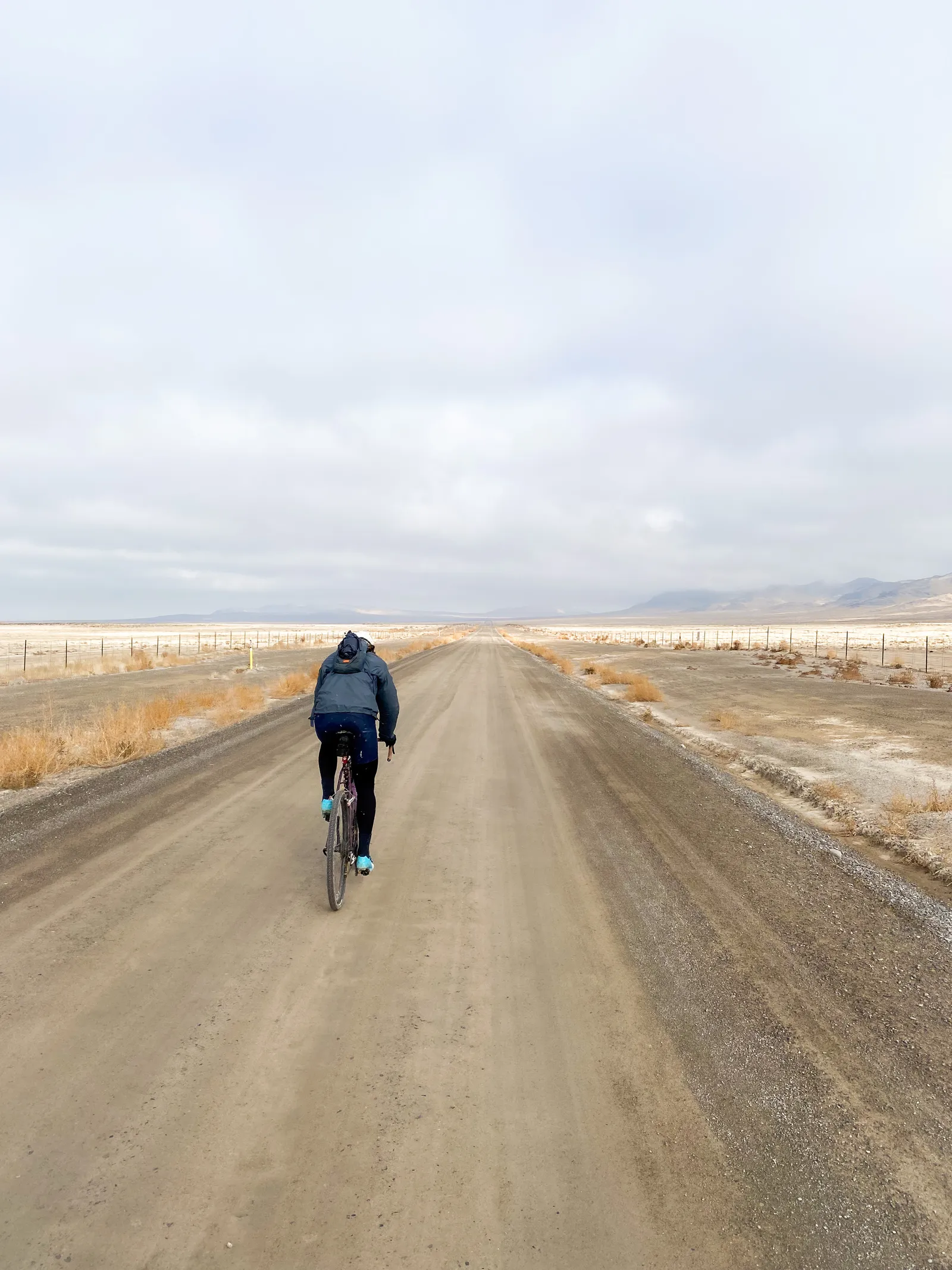
There is nearly no water or services for 150 miles of dirt road once you pass the town of Delle, which is mainly just one gas station. This was the section I was most excited for. These long stretches of desolate road pass through some beautiful great basin sagebrush valleys, and are rarely travelled on. This would also be the most challenging section, the road can be quite rough in places, with the causeway section being entirely made from fist sized sharp rocks. The roads further out have high clay content and can be impassable when wet.
Finishing this route in a day is a formidable challenge even for experienced riders. The section we completed was from Salt Lake to the base of the Promontory Mountains — this contains pretty much all of the dirt road and remote sections, which was my personal reason for wanting to attempt this route.
Gear and preparation
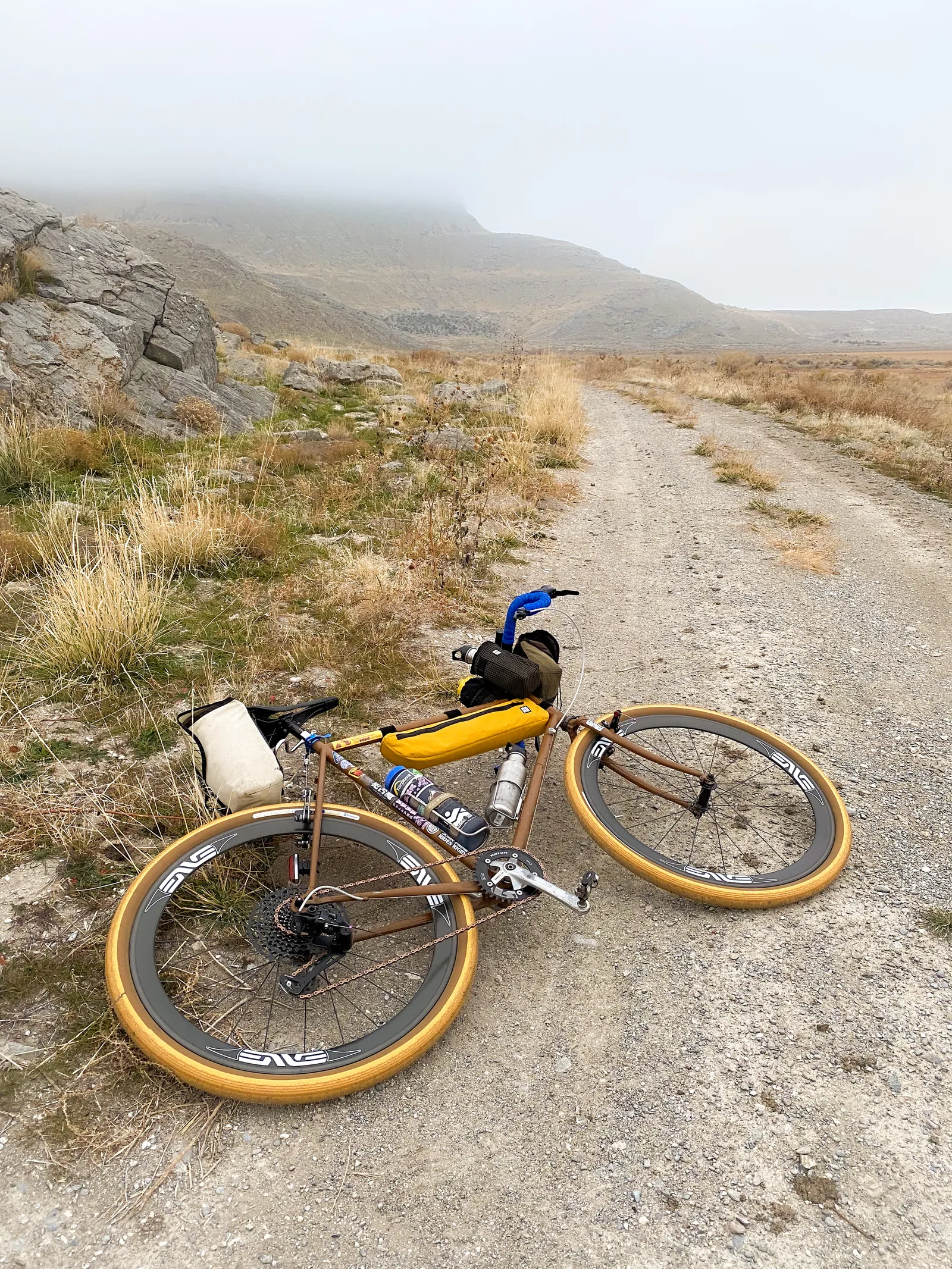
This ride was tricky to choose a bike for. It has long distances of pavement, but also some very rough sections — the bike needed to be capable and reliable, but also fast and efficient. I figured my Crosscheck would be a perfect fit. I ran 45mm slicks, which worked great for keeping speed on the pavement while also absorbing all of the rocky bumps, and keeping my tires from getting pinch flats. I carried about 4 liters of water on the ride, which in the end was overkill, but with water I am always happy to have too much rather than too little. Thomas decided to take his Saltaire gravel bike, a custom steel framed rim brake bike very similar to my Crosscheck. We both took extensive repair kits, plenty of snacks, and extra layers in preparation for the cold night.
For my bag setup I sewed a new mini framebag to carry tools and snacks, and used one of my micro panniers as a saddlebag to carry jackets and extra food. On my bars I had a small bar bag with accessories like gloves, sunglasses, sunscreen, and some more snacks.
The morning of the ride
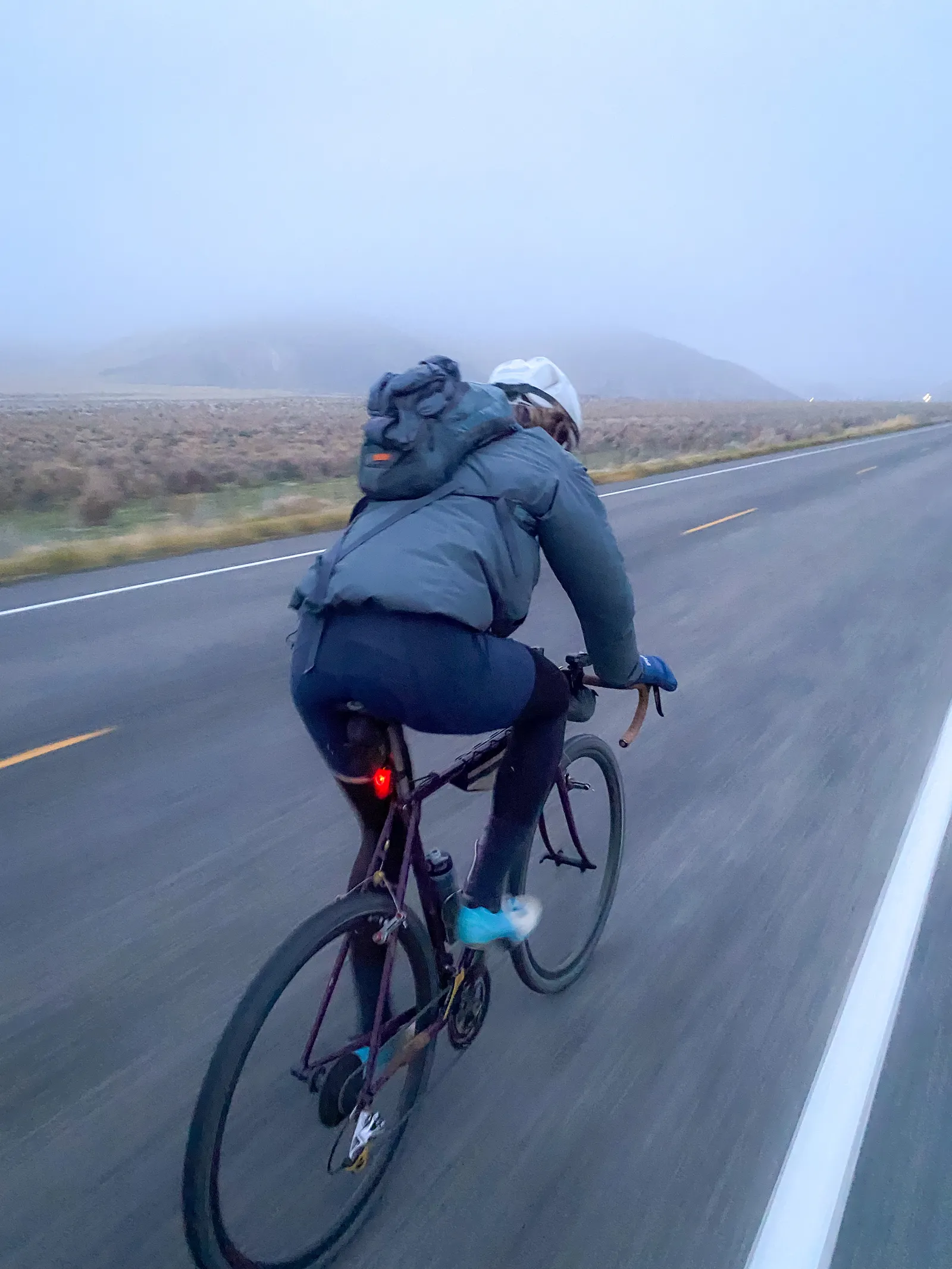
After an anxious night of sleep I woke up at 4 AM ready for the ride. I hopped on the Crosscheck and met up with Thomas. It was a brisk foggy morning, and as we headed towards the lake the fog just kept getting thicker. Eventually we made it to our first obstacle, the Airport. In the daytime there is an open bike path that cuts through the edge of airport property, but at night the gates are all remotely locked. Luckily we were able to call into the airport security and they unlocked the gates. At this point we could only see a few feet in front of us. As we rode the fog stuck to our clothing and skin drenching us in water. After a few wrong turns in the fog we made it through the airport and were finally on the edge of the lake. Even though this would be one of the closer points we would get to the actual lake, we couldn’t see the water at all in the dark fog.
After a couple hours of riding on frontage roads, the sky started lighting up, and the mists started to evaporate. The morning mists still clung to the hills and rock formations as we passed, creating fantastical looking environments that looked like something from the Lord of the Rings. Even though we had just left the city it was starting to feel like we were leaving civilization. Eventually we reached our last resupply point, the Delle gas station. This was 60 miles into our ride, and was the start of the dirt roads. We stopped here for a while to warm up, dry off, and eat a delicious breakfast of gas station coffee, candy bars, and cold tamales. After finishing breakfast, and getting some funny stares from some of the Delle locals, we got back on the bikes and started down a sandy road.
Into the desert
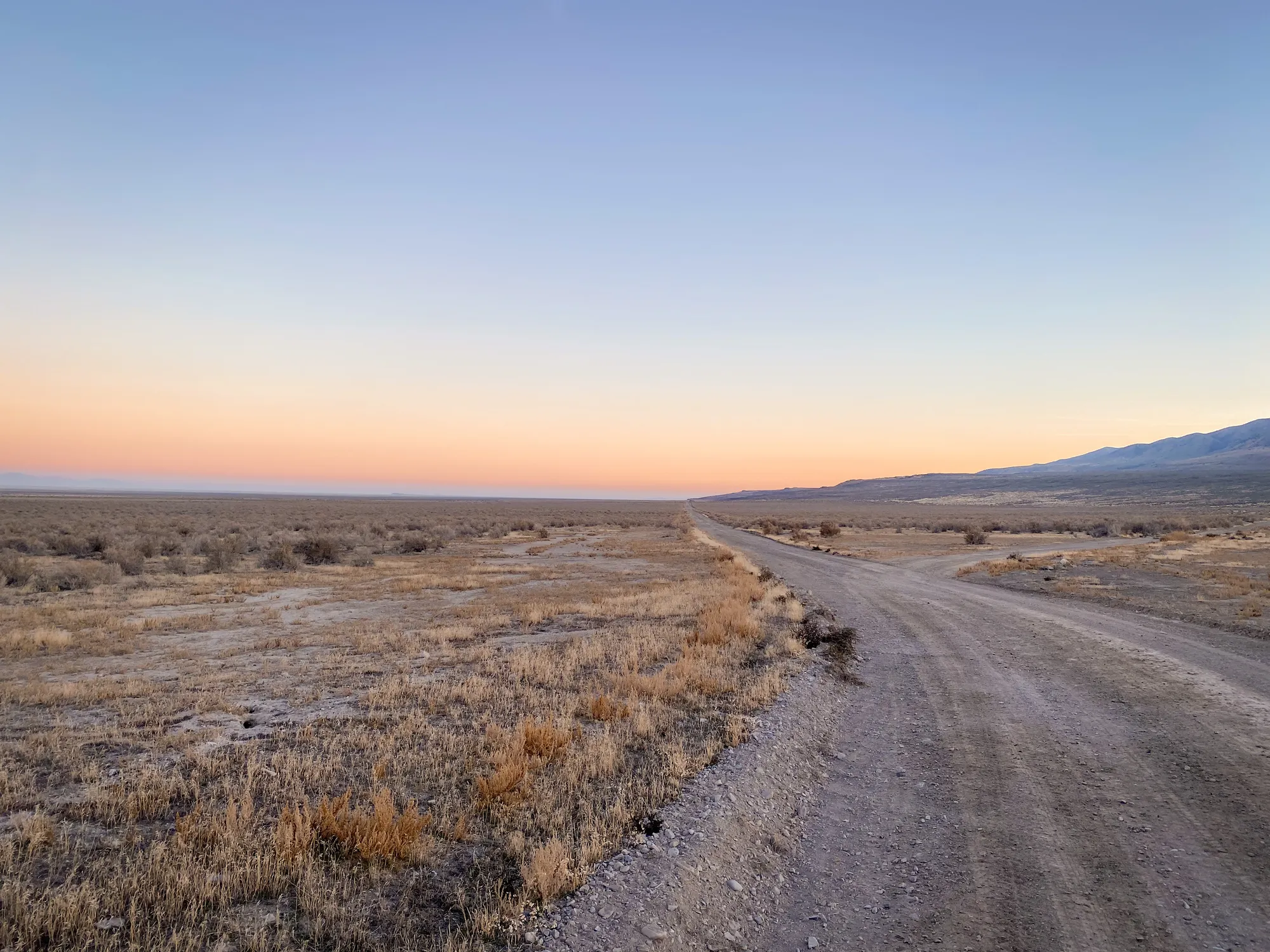
After riding on some dirt roads and sections of highway we made it to the UTTR Airforce bombing range — we had to cross through this to get to the causeway. While the range is in use the area is closed to through traffic, luckily today the gates were open and we rolled through without issue. Riding through the bombing range felt surreal, by this point the clouds had finally opened up and sun was shining through into the valley. The straight road went north into the horizon and to the east were rugged volcanic looking hills. The road was lined with a large barbed wire fence and warning signs to not leave the roadway. We were the only humans as far as we could see.
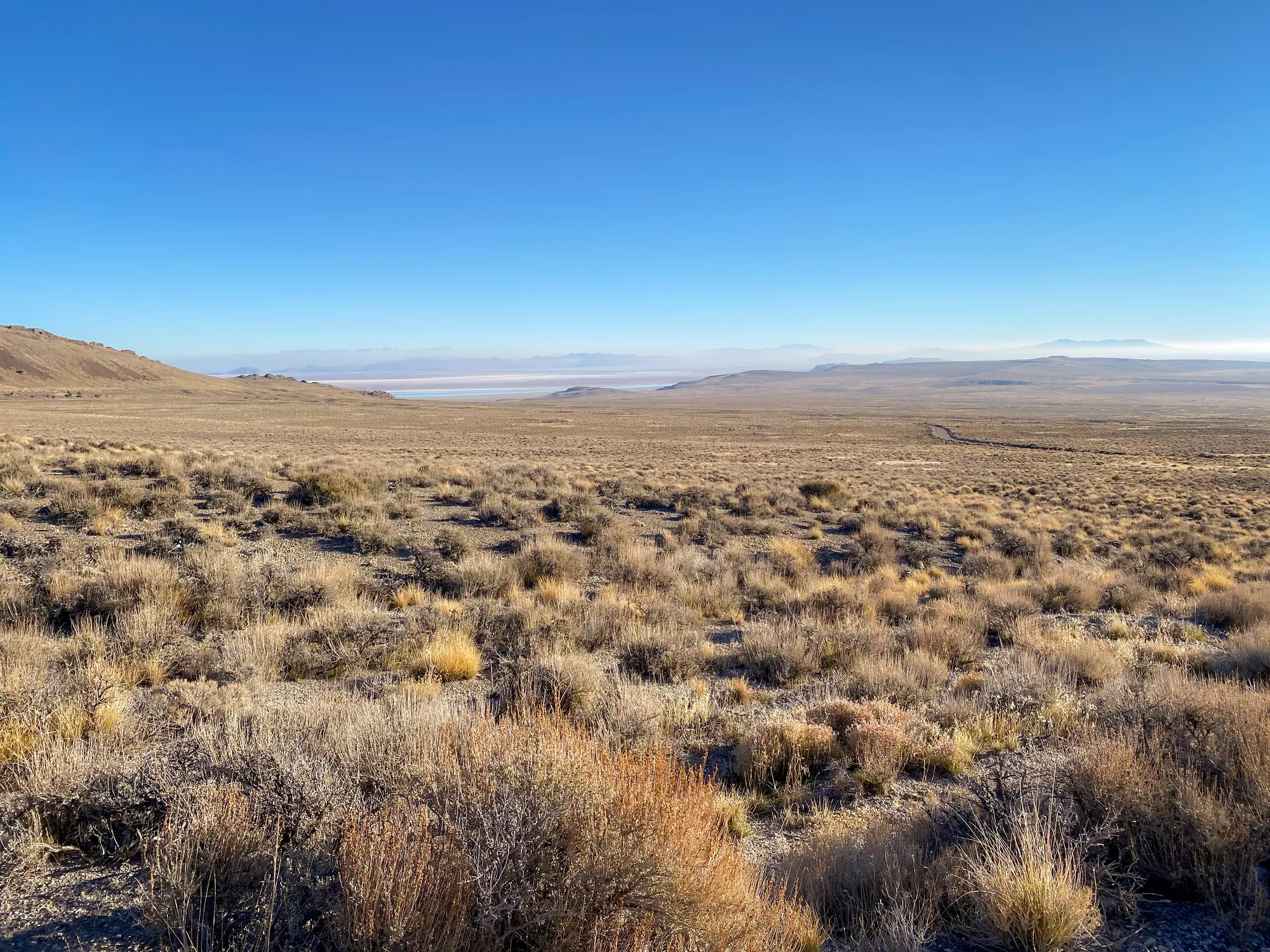
After 30 miles of biking straight north we finally came to the foothills of the lakeside mountains. We climbed for a bit and as I crested the hill realized that this was the first time I had actually seen the lake all day. Stretching out into the distance was an expanse of flat white ground, with water sparkling miles away, seeming more like a mirage than an actual lake. For years now the lake level of the Great Salt Lake has been dropping — increasing use for drinking water and irrigation mixed with low rainfall and less snowpack have caused water levels to grow lower and lower. At this point over half of the natural lake bed was exposed. While this created a beautiful surreal landscape of monotone flatlands, it was a little scary looking out and imagining what the future of the lake, and the rest of the Salt Lake valley, could look like in a future of diminishing water.
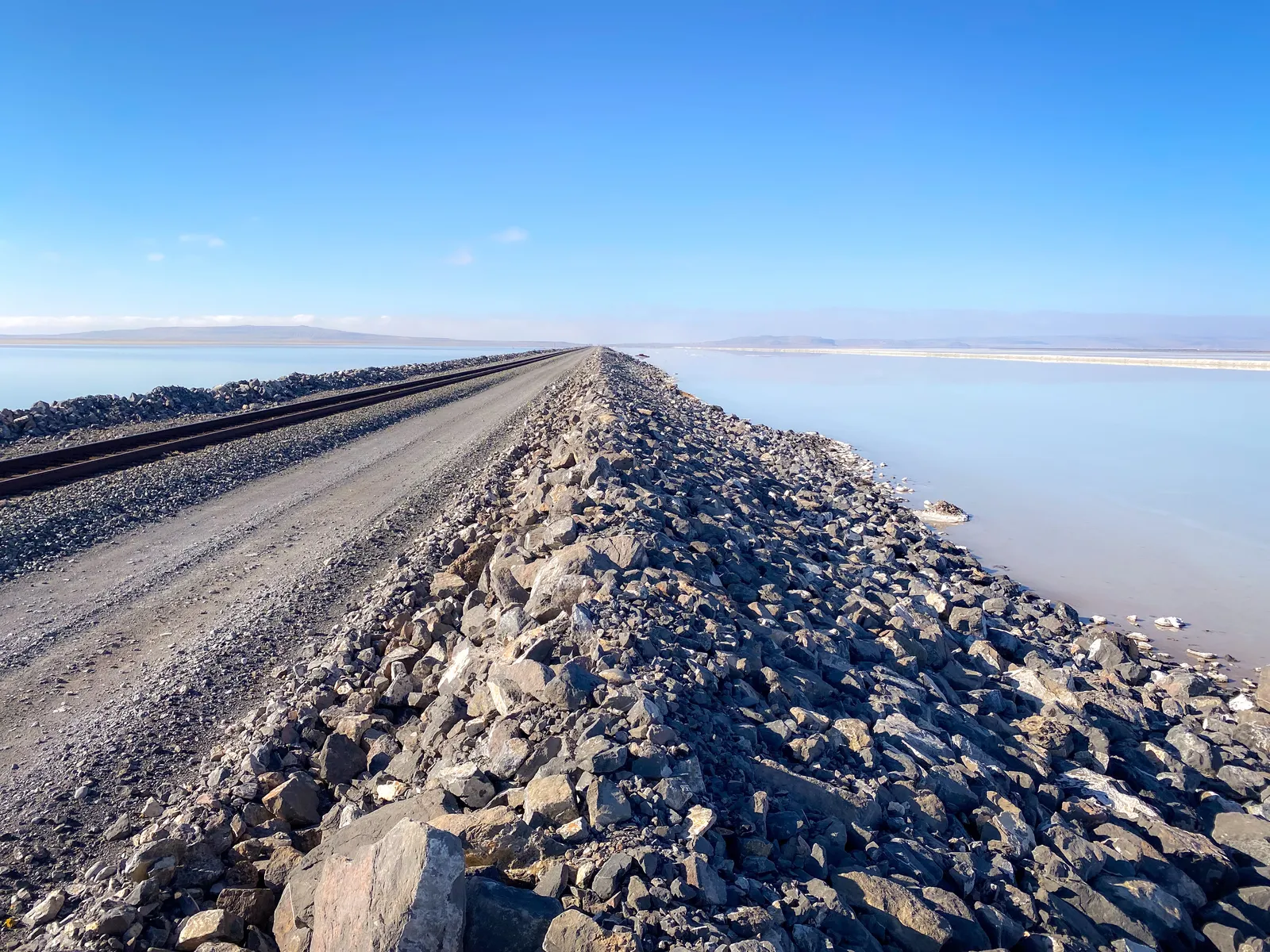
Looking to the west I got the first glimpse of the hardest section of our route, the rail causeway. The causeway is a section of raised railway bed that crosses the now mostly dry lakebed and was the only way to cross the lakebed to get to the Hogup Mountains. We rode down the hill to the edge of the lakebed, where we would be hopping onto the causeway. The causeway is constructed of large crushed stones, creating a sharp uneven surface. On the left side was the railway tracks, and on the right was the small service road that we would be riding on. On each side of the causeway muddy salt flats and occasional pools of lake water stretched into the distance. On the horizon I could see our exit point in the mountains.
We both took a second to prepare ourselves to be shaken up for the next 15 miles, then started along the stretch of road. About halfway through the bumpy ride I finally started to feel fatigue setting in, joints were stiffening up, and muscles were starting to ache. I kept bottoming out my tires to the rim on the sharp stones but miraculously I never got a flat. The end was in sight so I kept pushing on.
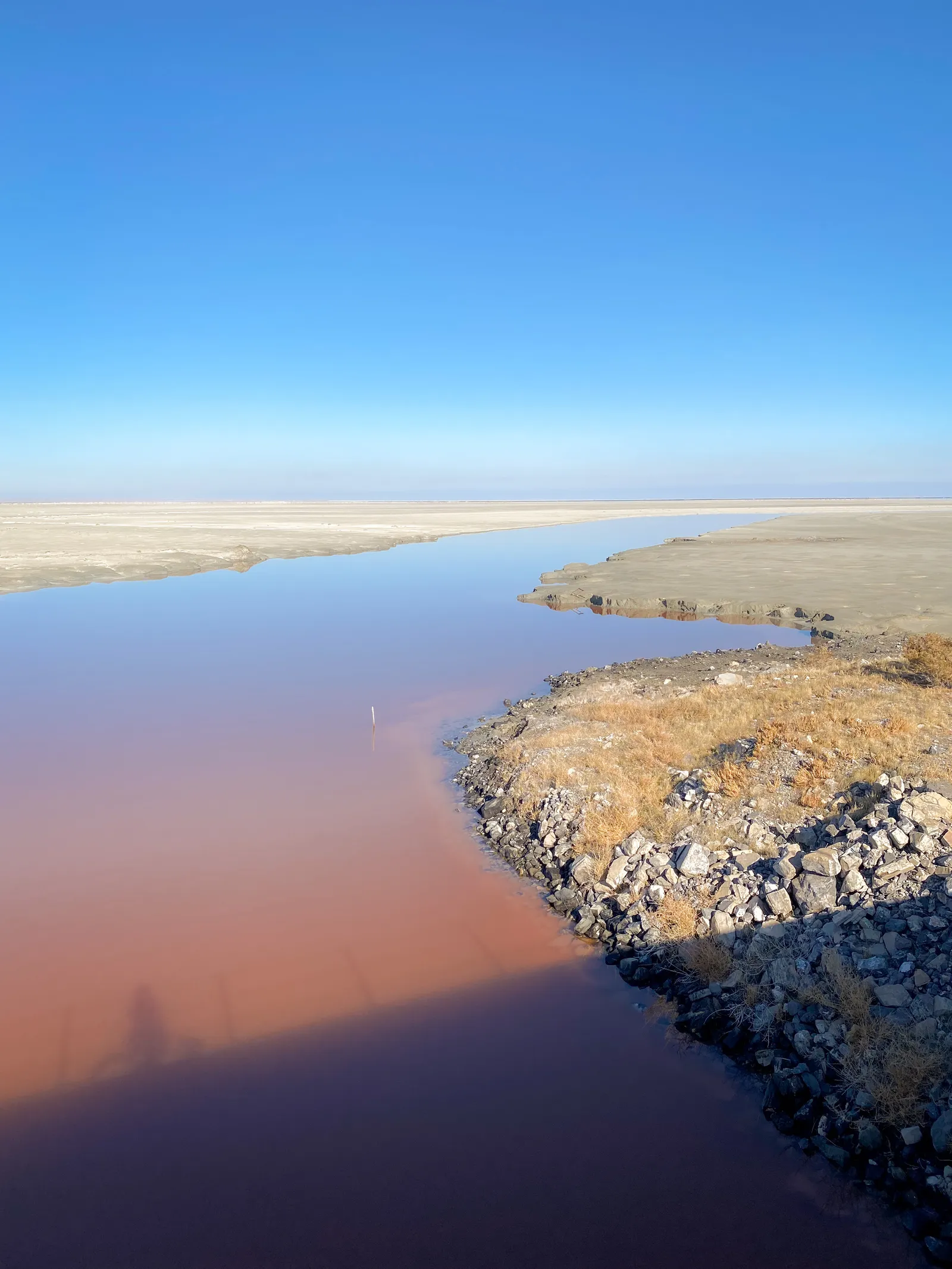
The landscape around me kept getting more and more alien as we neared the other side of the causeway. Pure white salt flats were cut by blood red pools and streams of water, in the far distance mountain tops rose over the lake. The landscape was like looking at an ancient dying animal, majestic and somber. Finally we reached the other side, rising up to meet us at the end was the West Desert Pumping Station. This giant now abandoned pump station was built in the 80s — at this time record rainfall caused lake levels to grow beyond normal levels, flooding towns like Farmington on the lake edge. As an emergency project the government built the giant pump station to empty the lake into the next basin, reducing flooding. It has not been used since, and now sits miles from the lakeshore, looking out of place in the middle of a mostly dry desert landscape.
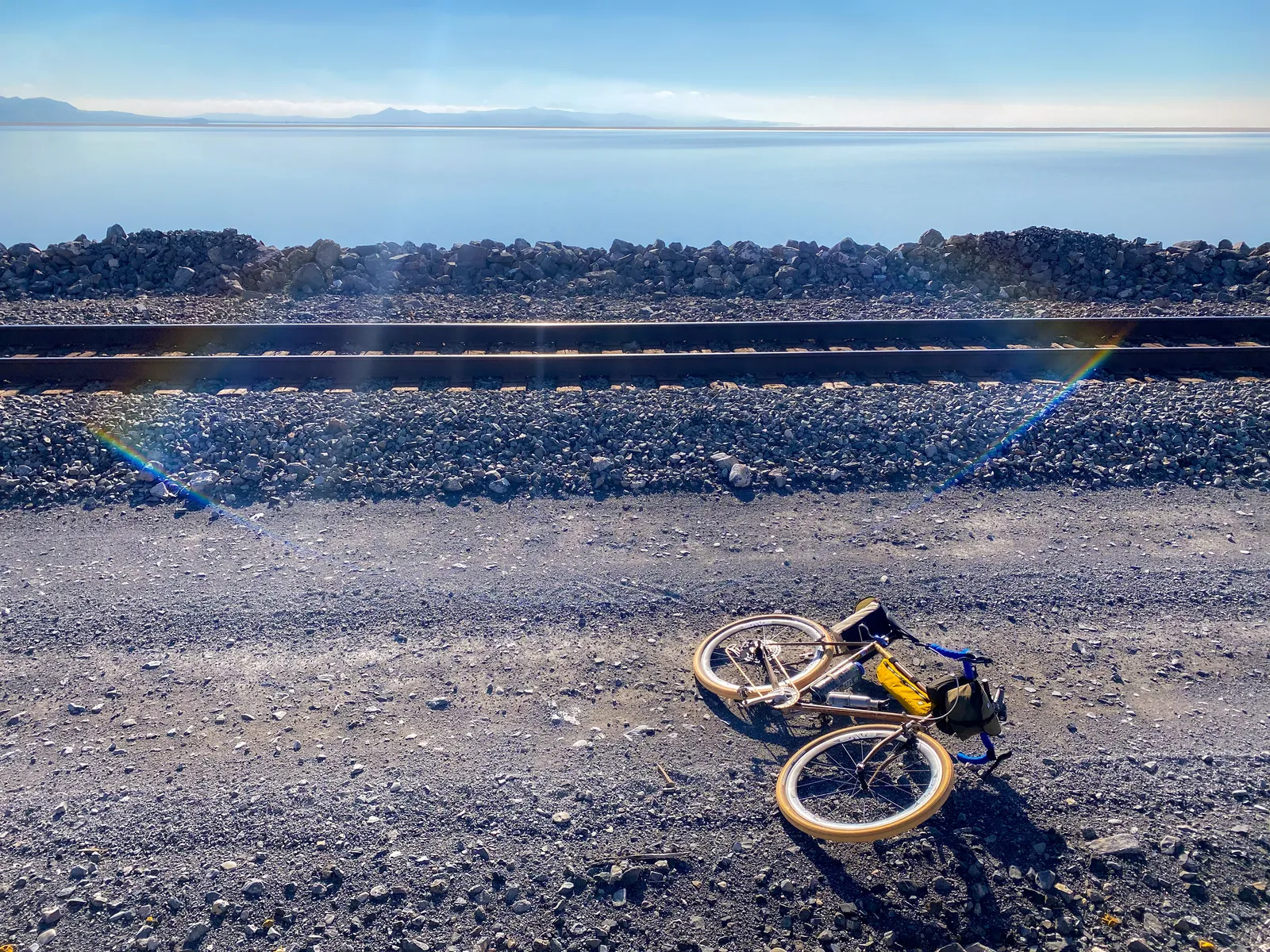
I was relieved to finally leave the rocky surface of the causeway and get onto some smooth dirt roads. We rode up onto a hill overlooking the tracks and sat down for a much needed stretch and food break. As I ate my packet of tuna and some bars I felt much better, but I also had the realization that there was no turning back now. We were as far away from civilization as we could get, and the only way out was to keep going.
Into the night
Now that we were on the far side of the lake we were really in the middle of nowhere. Getting to this point by car would take hours of driving on dirt roads, and there was not really any reason for people to be out here. The Hogup Mountains are surrounded on nearly every side by salt flats and desert, they are a peninsula jutting out into the old lakebed. While riding through the silent hills and valleys I could really imagine being the only person on the planet in this desolate landscape. The silence was only interrupted by brief conversation between us and the creak of our dusty bikes. At some point in the maze of old roads we ended up taking a wrong turn which led us up over a pass in the mountains. While it wasn’t a big climb it was a little disheartening doing more than we needed to after already being on the bikes for over 8 hours. We dropped down the other side of the pass and back down to the lake shore.
Since noon it had been a pleasant warm temperature, probably in the mid 50s, but after dropping down the pass the temperature started to quickly drop. After riding for a while longer along shore, the light started to dim as the sun went down. The sky made a beautiful gradient above the sagebrush desert as it transitioned into night. At this point we were at around mile 140, still with over 100 miles to go if we were going to finish the loop.
Failed attempt and ride home
As the sun went down it became more of a mental challenge than physical. Biking for hours looking at only a small patch of light in front of you makes you lose sense of time and place — there’s no context around you for how fast you’re going or how far you’ve come. Without the views of the desert my motivation started to decline.
The farther north we biked around the lake the colder it got. Our feet and hands started to go numb, luckily I had picked up some handwarmers from the gas station in Delle that were keeping me going. After a few hours of biking in the dark I reached for my water bottle and realized it was getting close to freezing solid — this is what really started to worry me. The next resupply point was Corinne, still almost 40 miles away. We kept on going and our pace was getting slower and slower. I’m sure Thomas could have kept up the pace, but for me the mix of cold, darkness, and exhaustion was catching up to me quickly. Finally at around ten at night we called our friend Doug to come pick us up.
As we were limping along in the dark, I turned off all my lights and looked up into the dark sky. The stars were perfect, a glowing carpet above the expanse of the desert and the lake. I was glad to have one last good view of the lake.
I eventually saw lights on the horizon as Doug’s truck sped towards us and I felt a huge wave of relief and gratitude for being able to stop riding. Big shoutout to Doug for spending his evening rescuing us, hopefully I can return the favor someday.
Even though we didn’t complete our goal of riding around the lake in one day, I was still glad to have done it. It’s always a good day when you are outside with friends. On the drive back we reminisced of the hardships of the day, and of what we would do next time. For me the biggest takeaway lesson is that I would never do this ride in the middle of Winter again. I could be convinced to try again, just maybe in the fall.
Thanks again to Doug for picking us up in the middle of the night, and thanks to Thomas for doing route planning and getting me out doing big stupid bike rides.
Comments
No comments yet. Be the first!